

PROJECT: INCOME CALCULATOR
discovery > research > launch > research round 2 > production iterations
Project context
-
Advocated for discovery to make sure the solution addressed the right problem, used user-centered design practices and research with consumers to quickly move into a build and launch for a tool consumers needed during a global pandemic.
-
Team make up, my role in the project. 7 team members (2 Product, 3 UX Designers, 3 Engineers).
I led the UX strategy, as well as user journeys, wireframing, prototyping, and final design handoffs with engineers.
-
Integrate into 2 existing tools, review >100 non-functional requirements, be responsive (discovery > implementation in less that 6 weeks).
-
Miro, Figma, development test environment.
-
Discovery: 4/16/2020-4/29/2020
Research, round 1: 5/21/2020 - 5/22/2020
Launch: 6/8/2020
Research, round 2: 7/14/2020
Iterations
The story
Background
Our stakeholders came to us with a seemingly simple ask:
Make an existing income calculator tool more prominent, so that consumers know it existed, so that they could use it to better estimate their annual income.
With COVID shifting the landscape, we weren’t confident the current tool addressed the right problems, especially for users with fluctuating incomes.
Despite stakeholder pressure to build immediately, we advocated for a one-sprint discovery phase to validate our hypothesis. To manage the perceived risk of this delay, we held check-ins every other day. It may have felt like ‘extra’ work in the short-term, but these went a long way to mitigate the risk our team was taking with this discovery and the solutions, as well as making sure stakeholders were able to guide the process.
Discovery & Define
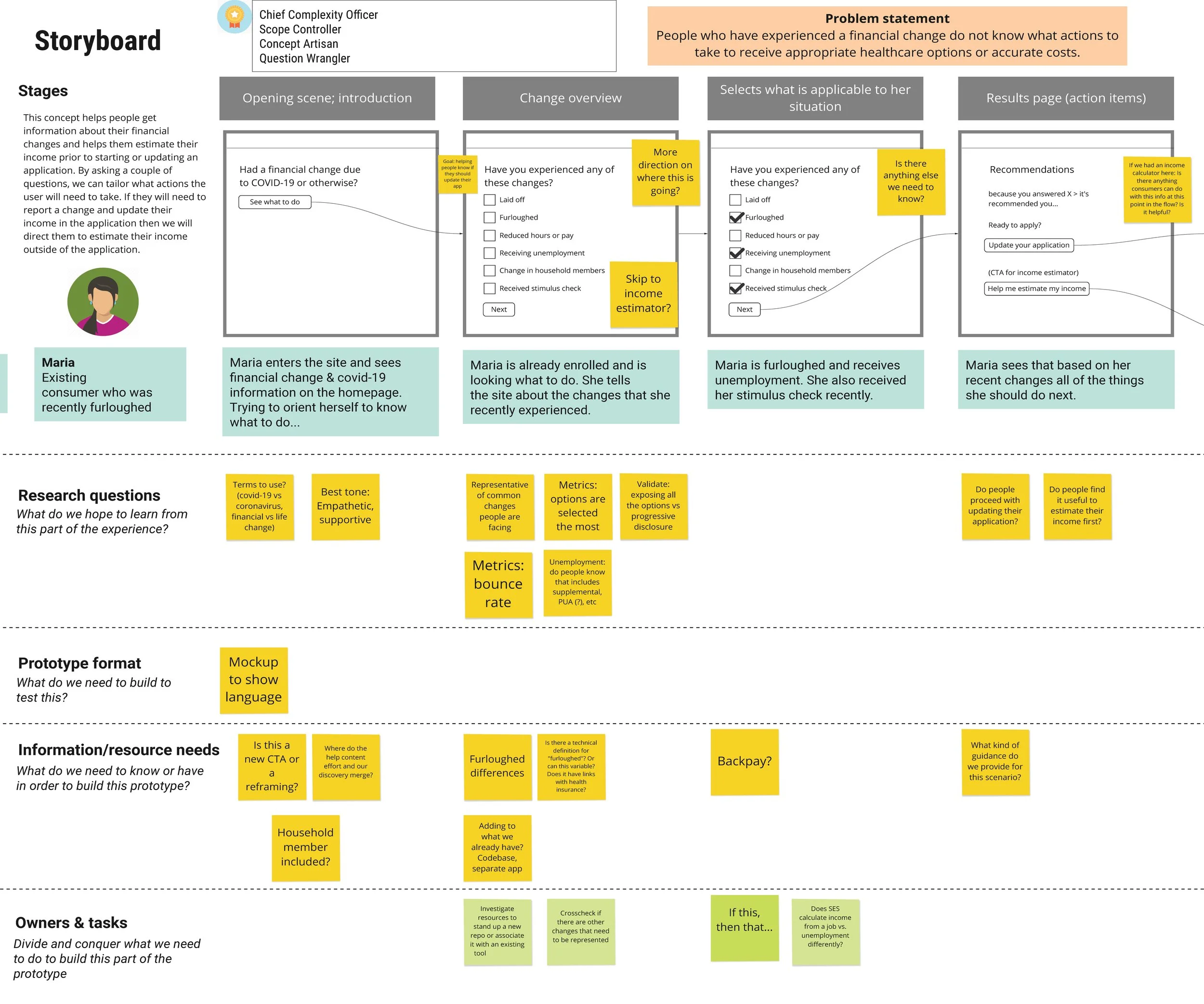
Our team spent the discovery sprint analyzing the problem from four key angles to get the full picture:
Understand the consumer: We mapped pain points across the entire journey, from the moment a user faces a challenge to when they finally receive their eligibility info.
Understand the current experience: We paired real call center questions with screenshots and videos to see exactly where people were getting stuck in the app.
Understand previous research: I distilled five years of research into a report on how people struggle with income types, inconsistent pay, and gross vs. net amounts to help guide our decisions.
Understand the tool within a pandemic: This was the toughest part. The world, and the official recommendations, were changing by the hour, and we were learning alongside our users.
The loudest takeaway from all of this was clear: we needed to find a way to streamline the process and make it as easy as possible.
We advocated for a broader problem statement to help more people: People who have experience a financial change do not know what actions to take to receive appropriate healthcare options or accurate costs.
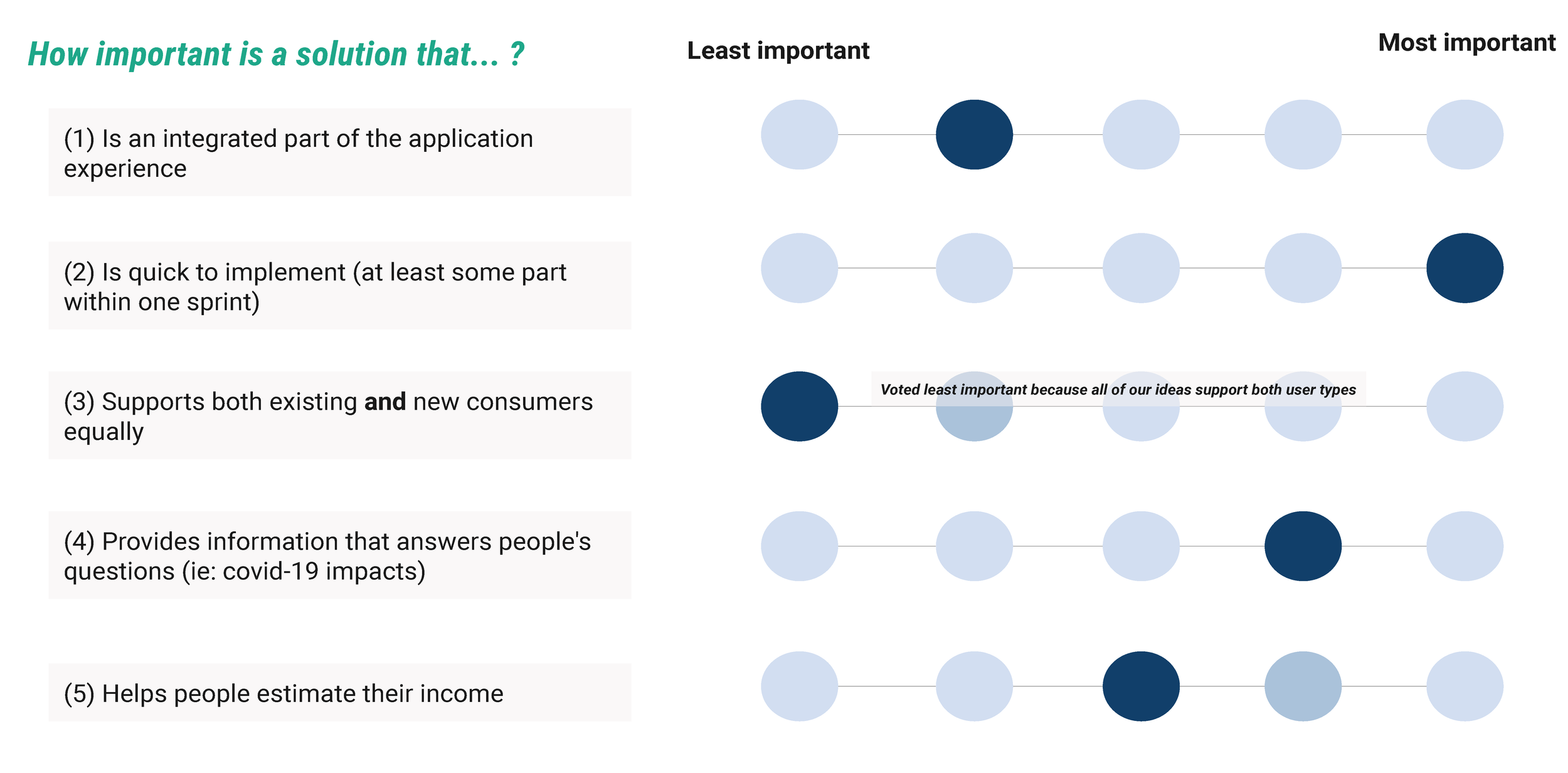
After aligning with stakeholders on this new problem statement, our team members then worked through an collaborative exercise to understand relative importance of criteria as we moved into solution brainstorming. We made it clear that while we did widen the space we were exploring, this did not assume a higher level of effort. There was an urgent need to get to production - a new, unknown scary thing in the world and our solution needed to be simple to use.
Ideation & Prototyping
After a few days of discovery, we jumped into a "Crazy 8s" session to brainstorm. We voted on the best features and merged them into a single concept, which we immediately vetted against our constraints.
To keep us on track, we constantly measured our idea against five key priorities:
Is an integrated part of the experience
Is able to be implemented in 1 sprint
Supports both new and existing consumers equally
Provides answers to people’s questions during an uncertain time
Helps people estimate their income
We moved into Miro to build wireframes and pull in design inspiration. After constant feedback from stakeholders, engineering, and policy, we went through 9 prototype iterations! This stage was all about those tough tradeoff conversations, but staying grounded in our original priorities helped us refine the solution until it was ready for engineering.
Build & consumer testing
And then wow, the effort was wrapping up! We got final stakeholder approvals, worked through non-functional requirements and wrote tickets for engineering.
The stars all aligned (the only time in 2020?) so that we could head to test this new tool with consumers prior to its public launch. I led the charge on defining what we needed to learn, then quickly sorted the feedback into clear priorities. After a workshop to align on pre-release must-have updates, we knocked out one last round of fixes. Just two months from our start date, we launched to the American public. In the first month alone, nearly 23,000 people used the tool to get their income reporting accurate during a really uncertain time. ♥️
More research and potential future work
Additional funding let us test and validate the first launch. While the results showed we were on the right track, they also revealed even more potential for the product, like supporting more income types and potential integration into other products.
Since we couldn't tackle everything at once, I took the lead on organizing the research findings. I mapped out each insight with its priority level, the effort required to fix it, and clear recommendations so the team has a solid roadmap for what to build next.
To keep the momentum going and make future updates easier, the focused on three main next step areas.
We led a project retrospective where we created a "recipe" so other teams could follow our fast-tracked discovery process.
I organized all our remaining research findings into a prioritized roadmap. I had the team review this so anyone can pick it up and know exactly what to do next when resources open up.
I teamed up with our analytics lead to build a dashboard to see exactly how people are using the tool in real-time, helping to make decisions on the tool moving forward.
Current status
This tool is live in production on the Healthcare.gov website and continues to receive regular product updates by the team managing the tool.
Project Retrospective
What went well?
Fantastic sprint organization by our product lead
Regular touchpoints with stakeholders to mitigate our team’s risks in the process
Engaging other teams (call centers, analytics, etc.) from the start to make those handoffs able to happen more quickly and smoothly
Time to do consumer testing and then integrate some critical improvements before public launch.
What can be improved?
Not enough time to write requirements and move to engineering (had to work extra hours to fit this in)
Unclear that there was a long list of integration requirements that needed review
Build in time after the effort so that team members can stay engaged
What did I learn?
Condensed timelines need a lot of prep to be successful and make the most use of team member’s time
* Cross-functional practice teams (product, engineering and design) are very impactful to have built from the start and to reduce handoff time when moving to testing or engineering (since all team members have already been involved)