

PROJECT: APPLICATION NAVIGATION, WAYFINDING, & EDITING
discovery > solution evaluation > strategic roadmapping > incremental implementation
Project context
-
A 10-week, cross-functional discovery initiative designed to untangle an application’s rigid linear navigation and establish a unified, long-term strategy. By framing a "Build to learn, plan to grow" roadmap, the project built the foundational architecture for future updates.
-
Cross-functional team spanning UX designers, product, frontend/backend engineers, analytics, and policy, business, research, call-center, and content stakeholders.
Co-lead UX strategist & discovery facilitator (co-authored the proposal, designed and facilitated the 10-week discovery, led evaluation frameworks, and drove strategic roadmapping).
-
Proposed concepts were required to re-use existing codebase structures and solve persistent pain points for 2+ distinct user groups simultaneously (first-time applicants, returning consumers, and call center power users/agents).
Preserve critical user data across non-linear navigation by synchronizing backend architectures without triggering data corruption or unexpected scenarios.
Advance at more than one discovery pillar (wayfinding, editing, or navigation) and drive core application metrics.
-
Miro, Sketch, Confluence, Jira, development test environment.
-
Discovery Program Increment (5 Sprints / 10 Weeks): Early 2021
Incremental Handoffs & Multi-Year Rollouts: 2021 – Present
The story
Background
For years, applicants on a federal healthcare application faced a persistent structural trap: returning to edit a previously answered question or check a entry forced them through an "unexpected edit journey." The system required users to re-verify every single subsequent page in a linear sequence.
Earlier insights from our ecosystem-wide service map had already illuminated a critical consumer gap: "Consumers do not know what to expect for application and enrollment before they get started." Smaller localized fixes weren’t fully taking into account the underlying system architecture. Recognizing that our stakeholders were ready for a structural change, my co-designer and I authored a proposal to pause ad-hoc patching and allocate a full program increment (5 two-week sprints / 10 weeks) dedicated entirely to deep discovery, technical evaluation, and long-term strategic alignment with a cross-functional stakeholder team.
The discovery journey: Facilitating alignment over 5 sprints
We deliberately structured the 10-week discovery increment to break down functional silos, engaging product, engineering, policy experts, and analytics as co-creators throughout the problem-framing and evaluation phases.
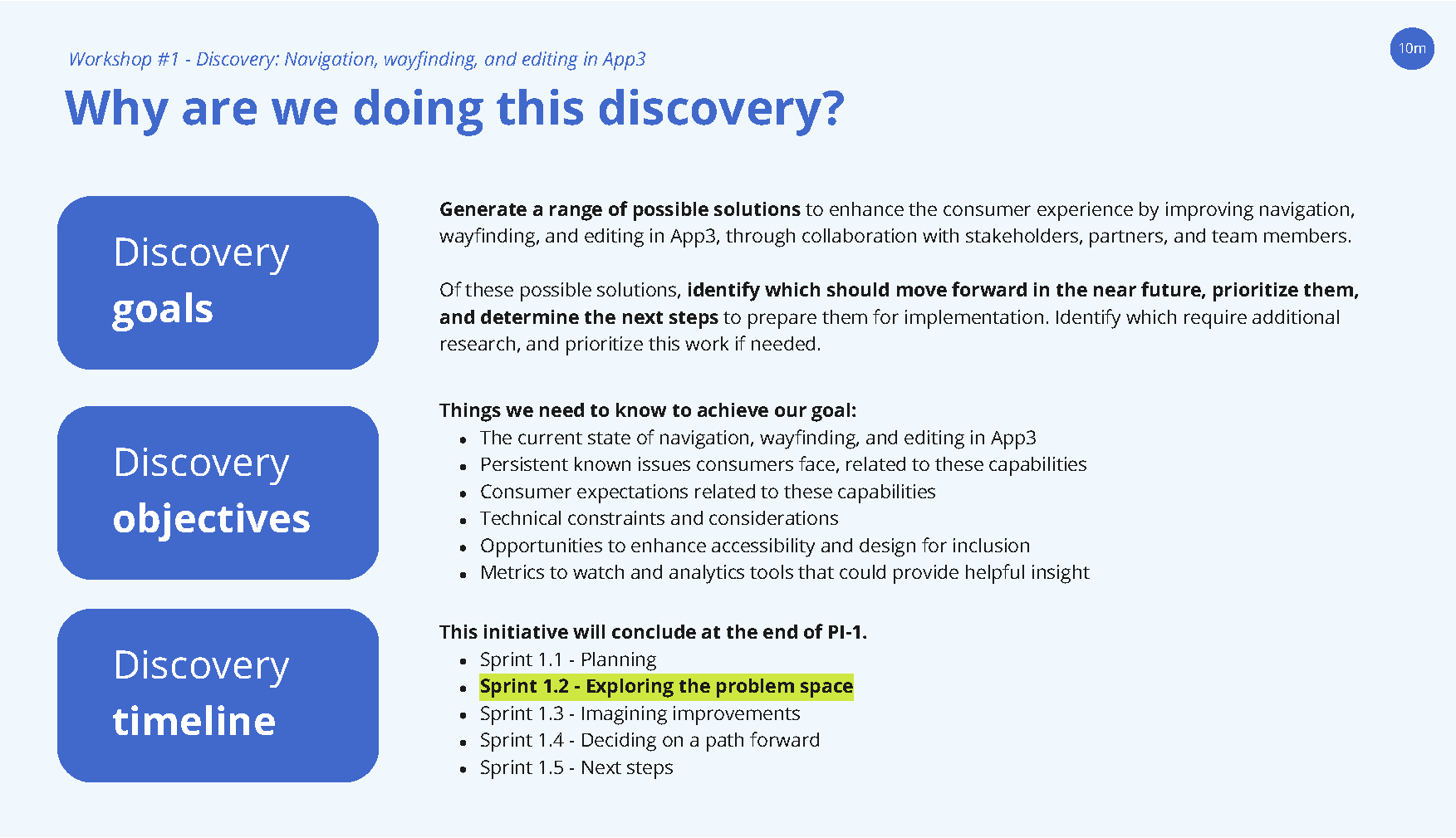
Sprint 1.1 (Planning the Discovery)
We audited navigation, wayfinding, and editing across the application mapping the current capabilities and known pain points from user research. Working directly with backend engineers, we unraveled how linear navigation constraints were tied to core backend mechanisms. Mapping these boundaries early ensured any proposed solution would be technically viable.
Sprint 1.2 (Exploring the Problem Space)
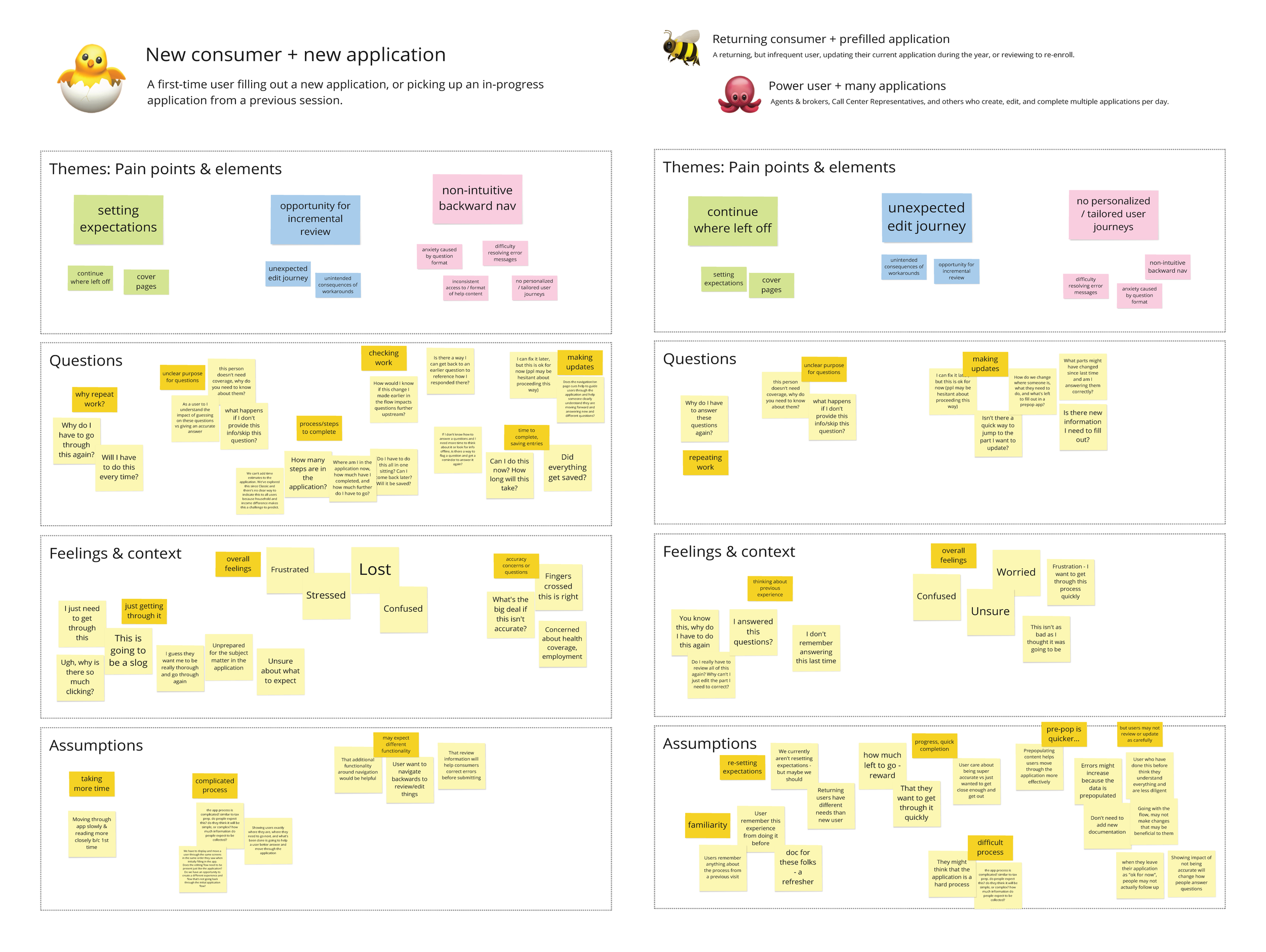
During this phase we kicked off Workshop #1 with stakeholders, to review the system architecture, add additional pain points, and better understand what questions users might have, what they might be feeling, and any assumptions we were making.
Sprint 1.3 (Imagining Improvements)
Through collaborative workshops with stakeholders, we explored possibilities across the three focus areas:
Wayfinding: Setting clear expectations up front and helping consumers track progress.
Editing: Enabling targeted corrections without triggering unnecessary repeat journeys.
Navigation: Providing intuitive forward and backward paths that respect user entries.
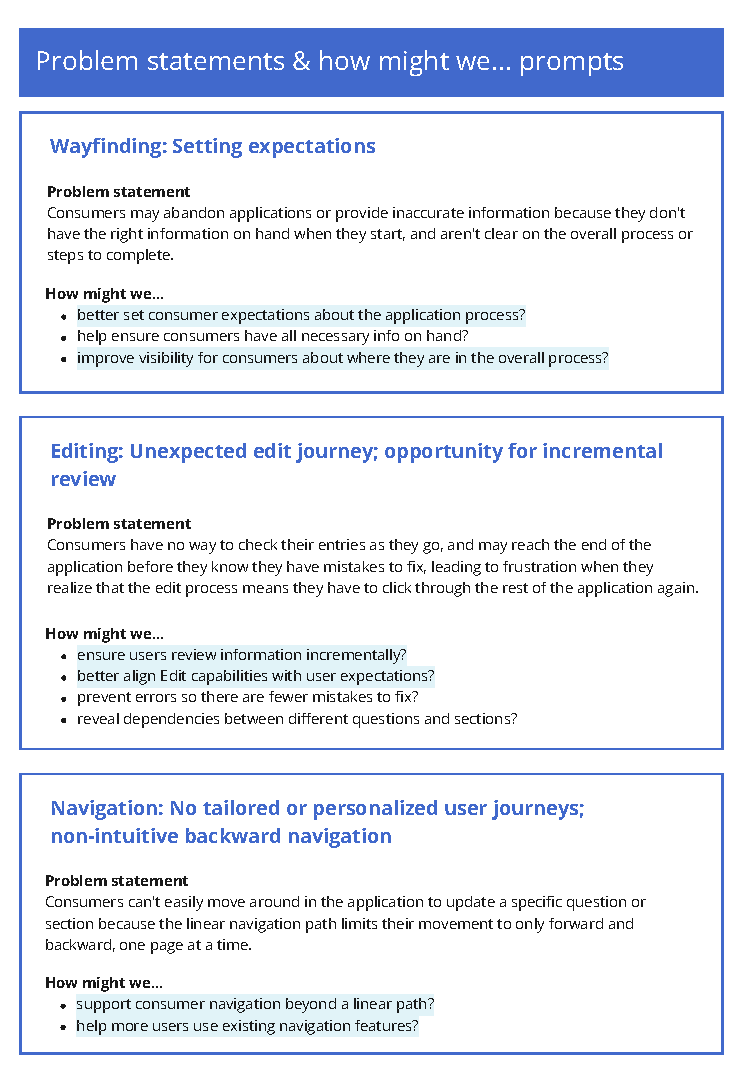
Sprint 1.4 (Deciding on a path forward)
A core pillar of my design strategy is to draft concrete problem statements early for stakeholders to react to, rather than drafting on the spot. Synthesizing research from earlier workshops, we presented three refined Problem Statements and How Might We frameworks during Workshop #2 to align the team around core user needs.
Evaluating Solutions & Navigating Trade-Offs.
To objectively evaluate solutions, I applied a multi-criteria scoring matrix:
Anticipated UX Improvement: Direct reduction in friction or error rates.
Multi-User Group Impact: Must solve pain points for 2+ distinct user groups (e.g., first-time applicants, returning consumers, and call center reps/brokers).
Cross-Capability Coverage: Touches wayfinding, editing, or navigation.
Technical Structure & LOE: Feasibility within current backend components and team capacity.

Navigating a Key Strategic Trade-Off
Data-wise, Section Summary Review pages scored highest in our evaluation matrix. However, during a formal confidence vote with stakeholders, we identified that jumping straight to section editing without an overarching structural anchor created ambiguity. Stakeholders preferred starting with the Overview Page to establish a stable structural foundation first. Agreeing with this feedback, we prioritized the Overview Page as Phase 1 for implementation.
Sprint 1.5 (Next Steps): This sprint was dedicated to making sure the discovery working was clearly documented for future reference and that the first two prioritized sub-work streams of application sections and an overview page were ready to kick off when capacity allowed.
Using my concept of "Build to learn, plan to grow," we converted stakeholder buy-in into a sustainable, multi-year product roadmap:
Phase 1 (Foundation) — The Overview Page: Grounded in the Benefits Playbook principles for a "welcoming front door," the Overview Page established expectation-setting up front and created the layout anchor for future features.
Phase 2 (Application structure) — Section Intros & Topic Editing: Phasing in section-level wayfinding and topic-based review pages across subsequent product cycles.
Phase 3 (Critical capablitiy) — Resume In-Progress Application: Integrated directly onto the Overview Page, enabling returning consumers to save progress and pick up where they left off.
Measurable Impact & Long-Term Outcomes
For the first 6 months of 2023, after the key resume in-progress application functionality was implemented:
4,161,294 Returning Consumers (20%+ of all returning applicants) were given the explicit option to resume or restart their application during Open Enrollment 11.
65% chose to resume directly where they left off, removing repetitive data entry burden.
35% chose to restart from the beginning, using the feature intentionally to review previously entered information.
Project Retrospective
What went well?
Early problem statement facilitation: Pre-drafting problem statements for stakeholder reaction accelerated consensus and prevented subjective scope creep.
Confidence voting & trade-off navigation: Combining objective scoring with stakeholder confidence votes ensured the final roadmap was both user-centered and organizational-ready.
"Build to learn, plan to grow" Philosophy: Establishing a strategic vision gave cross-functional teams a shared north star without falling into waterfall delivery traps.
What can be improved?
While we had the 10 weeks for this particular initiative, that’s not always the case. Pinpoint key meetings, artifacts, and decision points so that this could be run on a compressed time-frame, if needed.
When feasible, bring in the users to this process. Our contract constraints didn’t allow it, but co-creation of all of these steps with all users to enhance accessibility and inclusion is very important.
Establish a formal "check-in" trigger for multi-year roadmaps: Because execution was spread across several product cycles, defining a lightweight re-evaluation protocol at the start of each new phase ensures that shifts in underlying policy or platform architecture are systematically captured before kicking off feature design.
What did I learn?
Ecosystem insights can drive tactical discovery. Broad service mapping exercises (like our original Service Map) are invaluable for highlighting macro user pain points, even if subsequent tactical workstreams focus on specific product touchpoints.
Expectation-setting is infrastructure: Providing a clear, welcoming front door (Overview Page) is as crucial to user success as backend system performance.